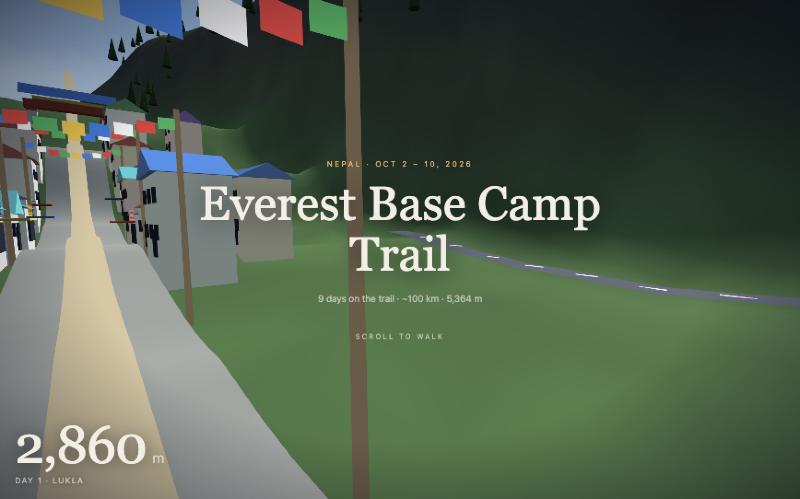
On September 30, 2026, I boarded a flight to Kathmandu with a rucksack packed light — only the essentials — and no real idea what twelve days at altitude would do to me, or to the nine strangers I was about to spend them with.
This is the full account. Every day, every metre, every headache I refused to medicate. I came back a different person. This is why.
The flight out of Hyderabad left at 11:30. Delhi was a layover — T1 to T3 transfer, which anyone who has done it knows is its own small adventure. I killed the time with a Chicken Zinger burger and popcorn combo. Not the most heroic pre-Everest meal, but it existed, and I ate it.
Landed in Kathmandu around 8 PM. Our guide Laxman was waiting outside with a shawl, flowers, and a garland. A warm welcome for someone who smells like three airports.
Checked into Kwabahal Boutique Hotel in Thamel — a dormitory, plenty of foreigners, the kind of buzz that makes you forget you just flew for nine hours. Thamel at night is something: pubs, dance bars, neon, noise. In the dorm I met Sasha, a guy from the UK who had come for Annapurna Base Camp. Floods had shut the route, so he was pivoting to Manaslu Circuit instead and heading out the next morning. Nepal has a way of rerouting your plans and still delivering.
Indian SIM cards do not work in Nepal unless you activate a roaming pack on Jio or Airtel beforehand. Alternatively, pick up an Ncell SIM at Kathmandu airport. Most Thamel hotels have WiFi — enough for the first night.
Currency: 1 INR ≈ 1.57 NRS. ATMs are available in Kathmandu and Namche Bazaar.
Lights out by 12:30. Temperature outside: around 20°C. Cold, but nothing yet.
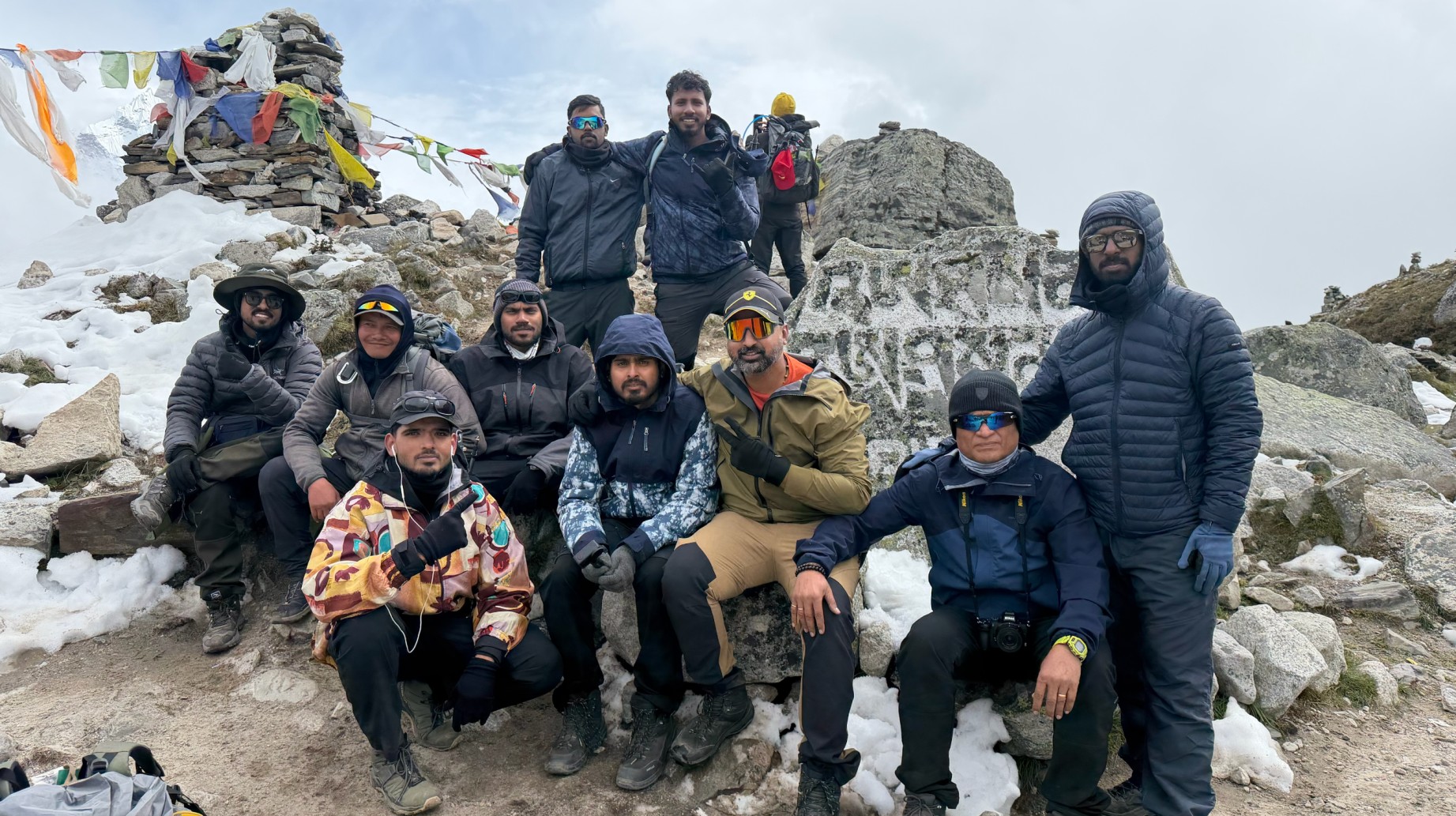
Woke up at 8. Walked over to Hotel Manang — five-star, significant upgrade from the dormitory. The group assembled for the first time. Ten people total: mostly from Chennai, one from Dubai, one from Bangalore. Nobody knew each other properly yet. We were about to spend twelve days on a mountain together.
Breakfast first — Subway in Kathmandu. Chicken Tikka sub (450 NRS) and a chocolate shake (200 NRS). Then out into Thamel market for last-minute gear. The market has everything. Shops lined with Nepali-made gear at prices that make Decathlon look expensive. We explored until 5:30.
That evening, dinner at the hotel with Nepali cultural dance — 1,400 NRS, worth it. Folk music, traditional costumes, warm food. A good way to ease into what Nepal actually feels like before you are five days into the mountains and have not showered properly.
Alarm set for 2:30 AM. Bed by 12:30.
2:30 AM. The alarm goes off and you question every decision you have ever made.
We headed to Ramechap Airport, five hours away by road. The drive is not kind — spine-rattling, narrow, barely paved in sections — but the Tama Koshi river runs alongside the whole way, and at 4 AM in the dark with just headlights, it is a strange kind of beautiful. Reached the airport around 8.
Flights to Lukla from Kathmandu are frequent and frequently cancelled — air traffic, weather, delays. Ramechap Airport, five hours away by road, is far more reliable. Most packages make this call. You sacrifice one night of sleep for a dependable departure.
Airlines: Tara Air, Summit Air, Sita Air. Fare: ₹16,600–₹21,200 approx. Baggage: 10 kg checked + 5 kg carry-on. The airport runs FIFO — show up and buy your ticket. No advance booking beyond one day.
The plane has twenty seats. Left side: Everest and Himalayan views. Right side: also mountain views. They hand out chocolate and sponge earplugs before takeoff. Flight time: 25 minutes.
Landed at Tenzing-Hillary Airport, Lukla — the world's most dangerous airport. Short runway, a valley at one end, a mountain wall at the other. You do not fully understand that reputation until you land.
10°C. Hotel Numbar, five minutes from the airstrip. Breakfast, permits sorted at the Sagarmatha National Park checkpoint.
Sagarmatha National Park entry: 1,500 NRS (SAARC nationals) / USD 30 (others). Khumbu Pasang Lhamu Rural Municipality entry fee: 2,000 NRS. Both required. Carry passport and permit copies — checked at Monjo checkpoint.
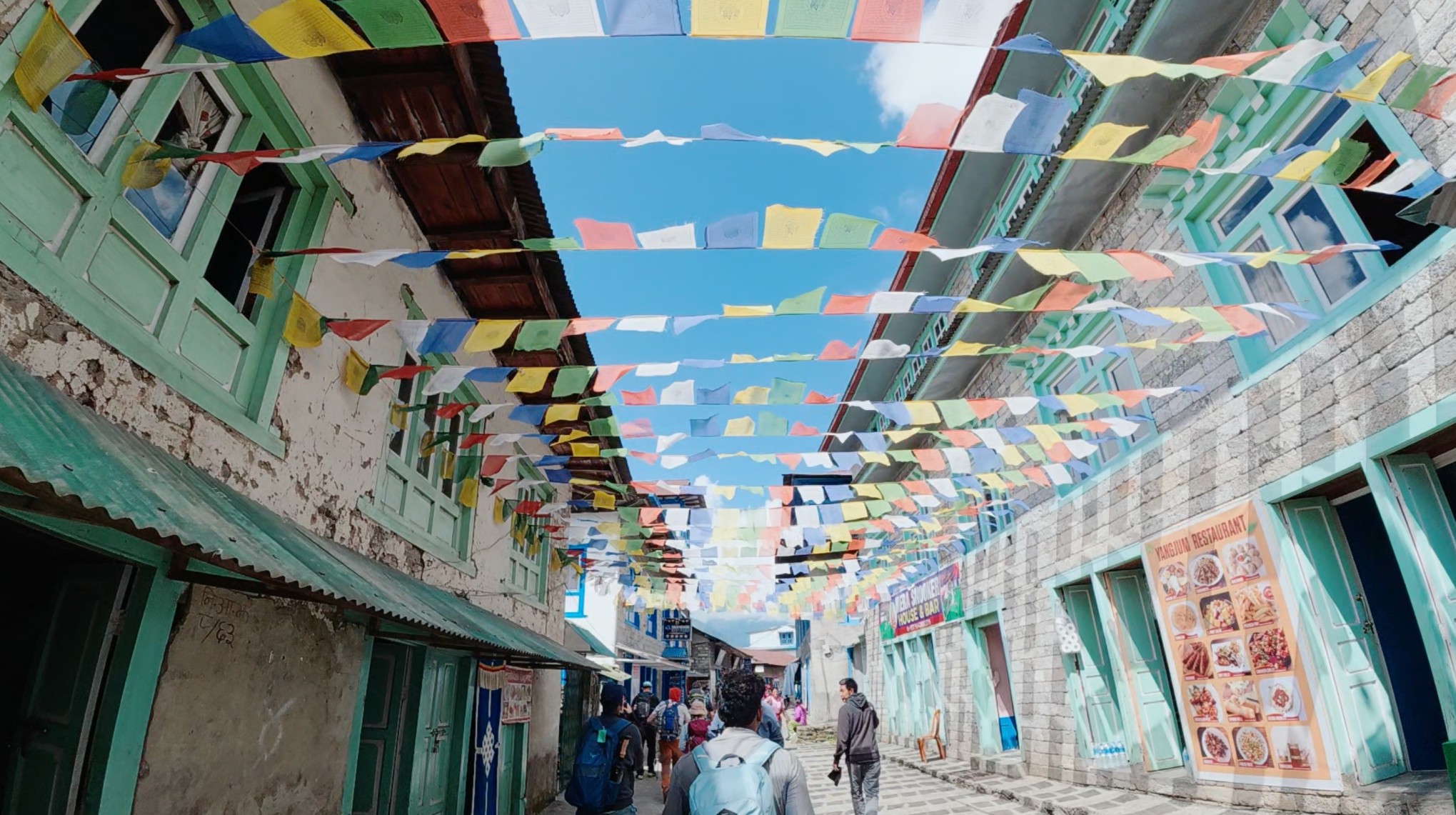
On the trail by 11:30 AM. Lukla is worth pausing for — a compact, beautiful village where you can watch planes land from twenty feet away. The first day's trek is gentle: mountains, forest, the Dudh Koshi river, friendly dogs that know the trail better than you do. Egg fried rice and black tea for lunch along the way.
Reached Phakding by 5 PM. Sunrise Lodge, with a straight view of the Dudh Koshi river from the terrace. Dinner: yak meat for the first time, chicken roast, black tea. Dense, chewy — not bad, just unfamiliar.
Bed by 8:30. Hot water: 100 NRS.
Up at 6. Breakfast at 7. On the trail by 7:30. Cold until the sun finally decided to show up around 9 — after that, manageable. Easy first stretch, river valley, the familiar rhythm already settling in. Then: the Hillary Bridge.
Named after Sir Edmund Hillary, it is a suspension bridge strung high above the Dudh Koshi gorge — Dudh Koshi meaning "Milk River", named for the white glacial water thundering far below — the kind of crossing that looks fine in photos and feels very different when the wind picks up and the bridge sways under your feet. Worth every second of it.
After the bridge, the path climbs hard. Stairs cut into the mountain, unrelenting, the kind of ascent that makes your thighs send strongly worded messages to your brain. Somewhere in the middle, I took a wrong turn — a lonely trail branching off into an ascending forest, no one ahead, no one behind. Harris, Yuvan, and Anirudh were playing in my ears and doing their level best to help. Eventually found my way back to the main trail and rejoined the group. Nobody needs to know how long that took.
Reached Namche Bazaar around 5 PM. Hotel Hill Ten.
Namche sits at 3,440 metres, built into the curved face of a horseshoe-shaped mountain. It is the main acclimatization stop on the EBC route — the place where your body is supposed to start adjusting before you push higher. The town has bakeries, gear shops, restaurants, WiFi. The hotel dining area had a warmer running, which felt like the greatest luxury imaginable — until you stepped outside into 2–3°C and the cold reminded you exactly where you were.
Dinner at 7:30 — non-veg Nepali Dal Bhat. The trekker's staple: lentil soup, rice, vegetable curry, and unlimited refills. There's a saying on the trail — Dal Bhat power 24 hours — and after a few days you stop thinking it's an exaggeration. Hot water: 200 NRS. Hot shower: 500 NRS. You start doing the maths on what warmth is worth.
Bed by 8:30. A light headache had quietly moved in — the altitude announcing itself for the first time. I skipped the Diamox. I wanted my body to adapt on its own terms.
Acclimatization days sound like rest days. They are not rest days.
Up at 6, breakfast at 7 — the full spread: cheese toast, fried potatoes, muesli, an omelette, Tang orange juice. Out by 7:30, climbing towards Syangboche at 3,860 metres. Moderate to hard in stretches, with several stops to catch your breath and remind yourself this was supposed to be the easy day. Panoramic snow-covered peaks in every direction, helicopters cutting across the sky, the occasional osprey overhead.
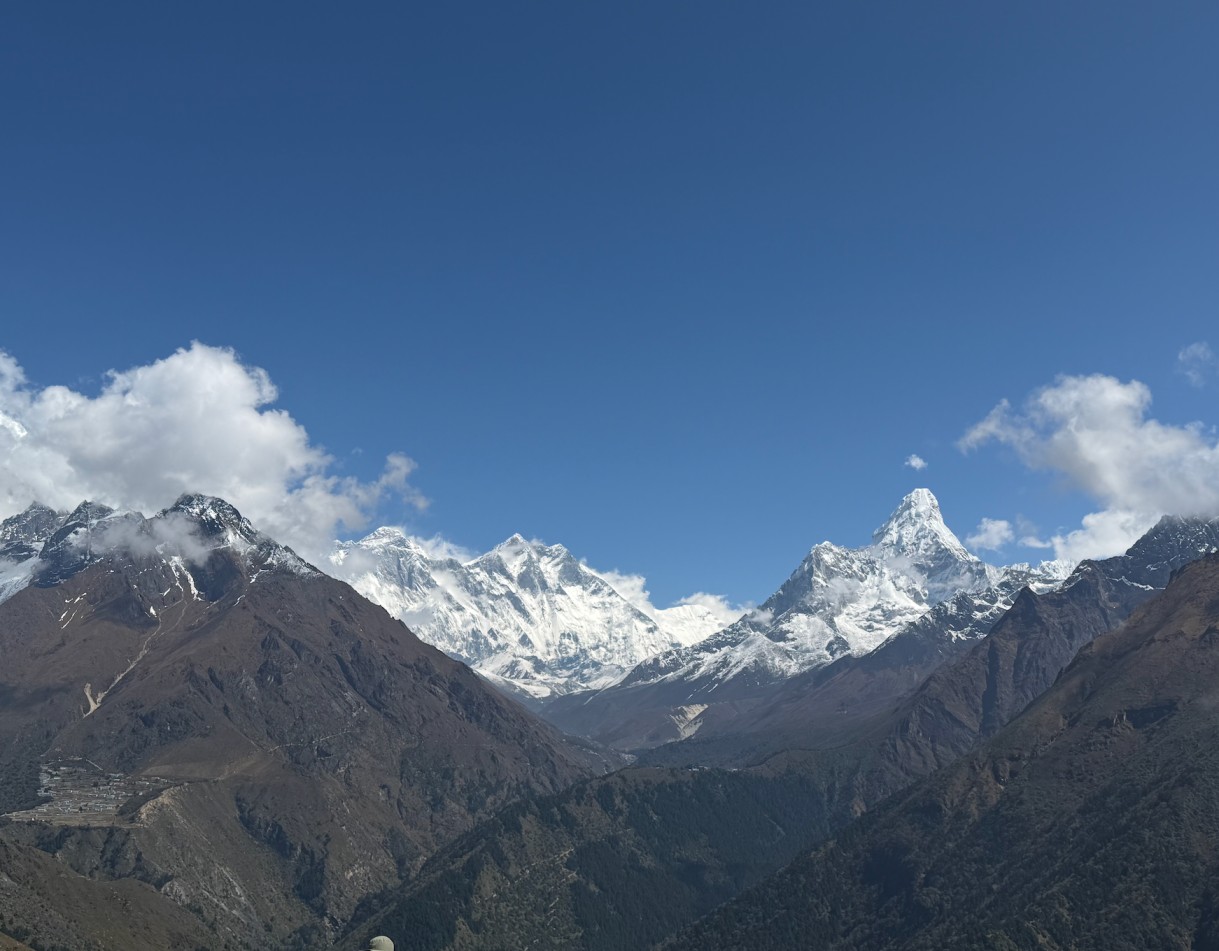
And then, for the first time: Mount Everest.
It appears almost quietly between the other peaks — Amadablam standing sharp and dramatic to one side, Lhotse, Nuptse and other six-thousanders filling the frame. Everest is further back, broader, more massive than towering — not the spike you expect, but the one that doesn’t need to be. You stop. You stand there. You take approximately forty-seven photos, none of which will do it justice. We spent an hour up there, mostly in silence punctuated by camera clicks.
On the way back down, we stopped at Sagarmatha Next — a sustainability centre and museum dedicated to cleaning up the mountain. A short film about the plastic waste crisis on Everest and the volunteers collecting it at altitude. Goosebumps, genuinely. I picked up a mocha madness in the cafeteria to support the cause — and because it was very good.
Back at Hotel Hill Ten by 1:30 PM. Lunch, a thirty-minute sketch of Namche from the terrace, a short nap. Wandered down into the market by evening. Dinner at 7:30 — non-veg Dal Bhat with chicken curry. Packed bags. Bed by 8:30.
Up at 6:30. French toast and black coffee at 7. On the trail by 7:45. The mist was low and the mountains kept appearing and disappearing through it — close enough to feel enormous, far enough to feel unreal.
The trail drops steeply out of Namche before climbing back up just as hard. You lose all the altitude you worked for, then immediately start earning it back. Difficult throughout. By the time we reached Tengboche at 3,867 metres (12,687 ft), the legs had earned lunch — veg egg fried rice. Tengboche sits on a ridge with Amadablam directly in front and Everest peeking behind. The monastery here is one of the most photographed spots on the entire route, and you understand why the moment you arrive.
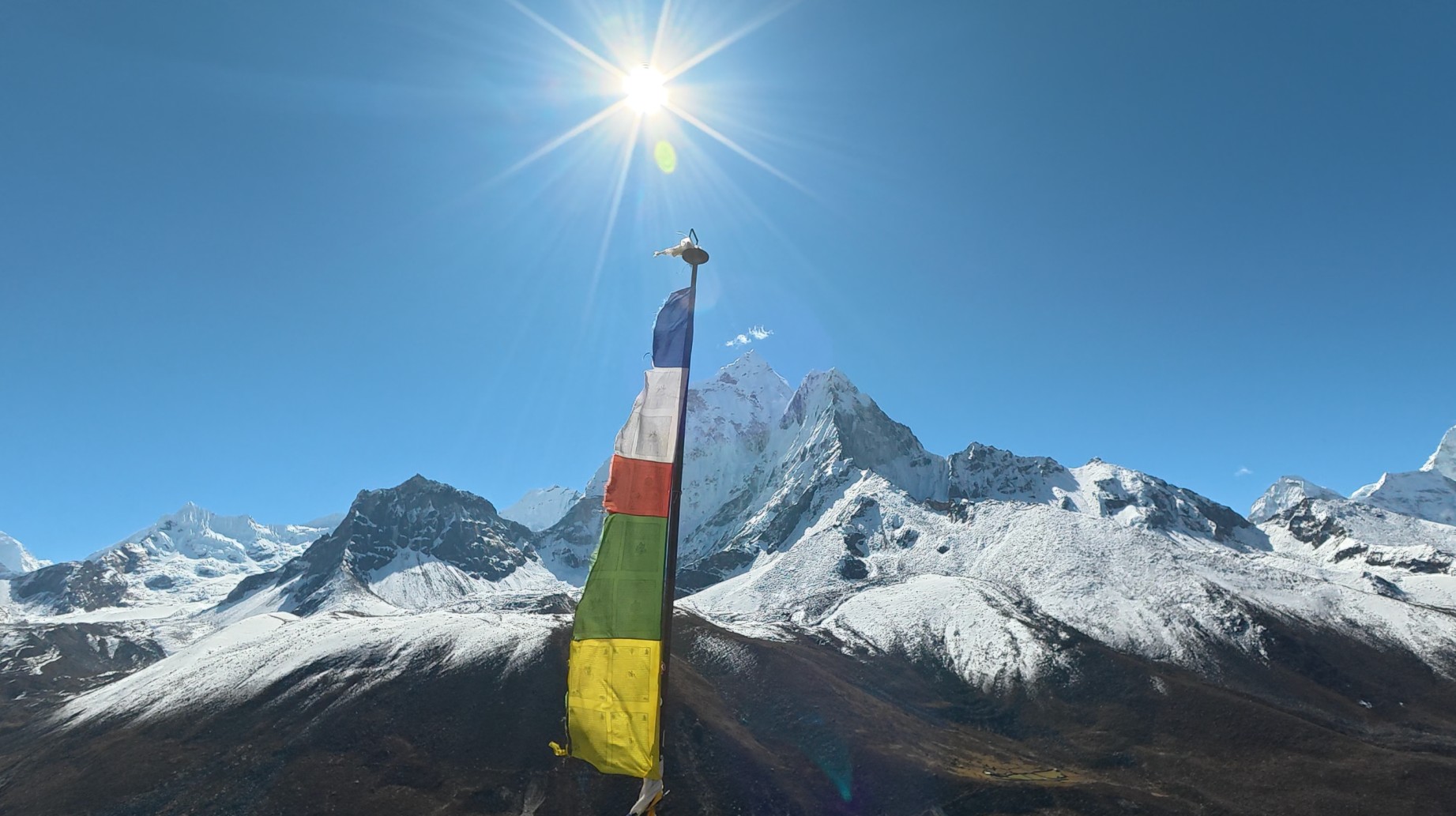
Reached Deboche at 3,820 metres by 3 PM — Paradise Lodge. Quieter, smaller, the kind of place where you play cards after a hard day because there is nothing else to do and that is exactly right.
The headache that had been a whisper in Namche was a proper presence now — mid-level, persistent. Still no Diamox. Drink water, rest, trust the process. Hot water: 300 NRS. Dinner at 7. Bed by 9.
Diamox (acetazolamide) is commonly recommended to prevent altitude sickness. I chose not to take it — I wanted my body to acclimatize naturally. This is a personal decision, not a recommendation. Light headache at Namche (3,440m), mid-level at Deboche (3,820m), both cleared with rest and hydration.
A severe headache, confusion, or loss of coordination are signs to descend immediately. Consult a doctor before your trek if you have any concern.
Up at 6. French toast and black coffee at 7. On the trail by 8. The morning was all snow-capped peaks and forest — the kind of walk that does not feel like effort because you are too busy looking around. Reached Hilltop Lodge at 4,040 metres (13,255 ft) by 10:30 for a non-veg Dal Bhat lunch. The altitude was climbing steadily now, and the body knew it.
Moderate trek through the afternoon towards Dingboche. Reached by 4 PM. Dingboche sits at 4,410 metres — you feel every one of those metres. Dropped bags and headed straight to Café 4410. Hot chocolate at 600 NRS, phone charging included, WiFi at 200 NRS. Played cards until 6:30.
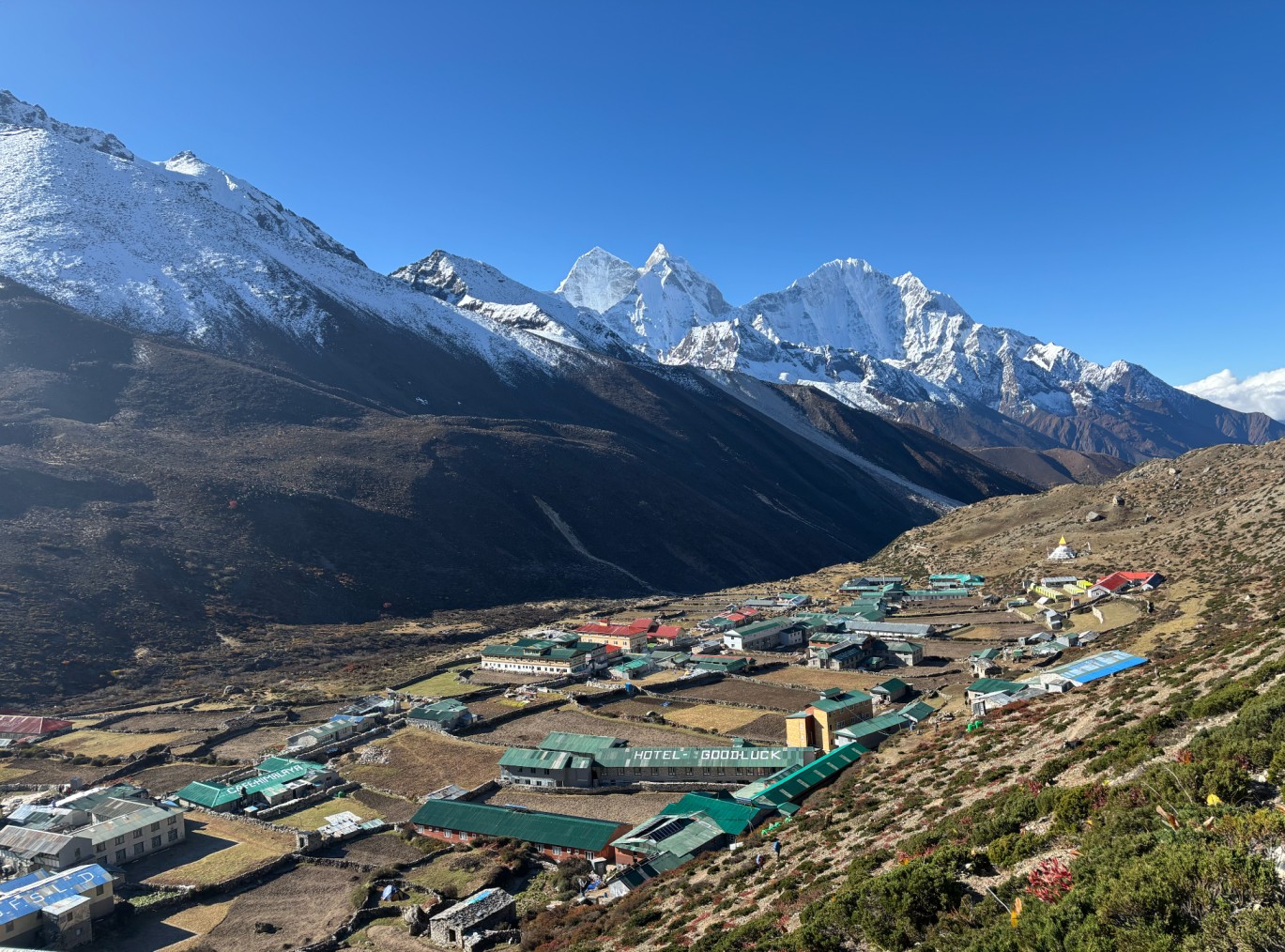
Back for dinner at 7. The headache from Deboche was still present — steady, making itself comfortable. Still avoiding Diamox. Hot water: 400 NRS. Then someone said go outside and look up.
Another acclimatization day. Another early start. Up and on the trail, climbing towards Nangkartshang Peak at 5,083 metres (16,677 ft). Three hours up, difficult throughout — the kind of climb where you stop counting steps and start counting breaths. The air at this altitude has a different quality: thinner, colder, every step more deliberate than the last.
But we made it. Stood at the top. Took in the full panorama.
It was my first ever mountain summit. I did not fully process that until I was already standing there — above 5,000 metres, Everest directly ahead, Amadablam to the side, the Khumbu valley sprawling below. Two hours back down. Returned in time for lunch.
The rest of the day belonged to Café 4410. Coffee, cards through the afternoon, stayed on into the evening. At 4,410 metres with tired legs and a persistent headache — still no Diamox, still adapting — that café was the centre of the universe for a few hours. No complaints at all.
Phakding (2,610m / 8,563 ft) — ~100 NRS
Namche (3,440m / 11,286 ft) — 200 NRS
Deboche (3,820m / 12,533 ft) — ~300 NRS
Dingboche (4,410m / 14,469 ft) — ~400 NRS
Lobuche (4,940m / 16,207 ft) — ~500 NRS
Gorak Shep (5,164m / 16,942 ft) — 600–800 NRS
No ATMs beyond Namche. Carry enough cash.
Up at 6. Breakfast at 7. On the trail by 7:30. Hard from the start. And somewhere along the way, the last of the small comforts quietly disappeared — no flush toilets from this point on. Just squat toilets, toilet paper, and the wet wipes you hopefully packed.
Crossed the Dughla waterfall bridge at 10:30 — a suspension bridge above a cascade with the valley dropping away below it. Then reached YAK Hotel in Thukla at 4,620 metres (15,157 ft) by 11 for lunch. After that: Thukla Pass.
The ascent after lunch is one of the hardest climbs on the entire route — steep, relentless, the altitude making every step cost more than it should. At the top sits Chukpi Lhara, the Everest Memorial — a field of stone chortens for climbers who never came back.
Babu Chiri Sherpa is among them. Born in Solukhumbu, he summited Everest ten times, set a speed record from Base Camp to summit in 16 hours 56 minutes, and in 1999 spent 21 hours on the summit without supplemental oxygen — a record that still stands. He died in 2001 at 35, falling into a crevasse near Camp II while taking photographs. Ten summits, and the mountain took him on an ordinary afternoon with a camera in his hand. You stand there reading the names and the mountain suddenly feels very different.
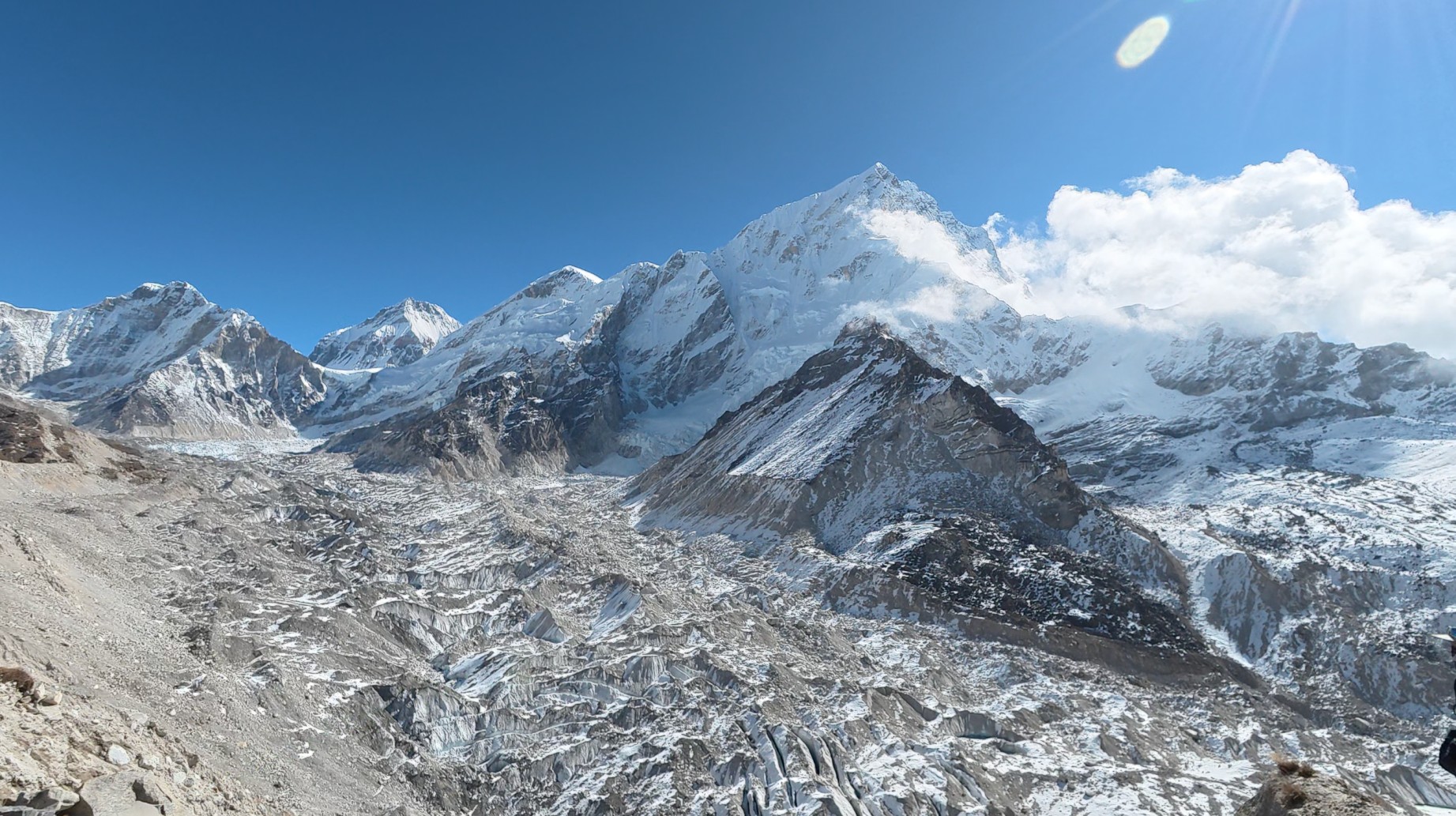
Then the first snow path appeared — just past the memorial, the trail turned white. A different world entirely, silent and cold and impossibly beautiful. Nothing prepares you for that first step onto snow at 4,800 metres with Everest ahead.
Reached Altitude Home in Lobuche at 4,940 metres (16,207 ft) by 3 PM. Evening in the café nearby playing cards, bed by 8. Hot water: 500 NRS.
Alarm at 5. Breakfast at 5:30. On the trail by 6:30. This was the day.
The trail to Gorak Shep is everything the mountain has thrown at you, compressed into one morning — muddy sections, gravel, loose rock, snow-covered paths, the air thin enough that you feel it in your chest with every step. Reached Himalayan Lodge in Gorak Shep at 5,164 metres (16,942 ft) by 10:30. Had a coffee. Left the bags. Then we turned towards Base Camp.
It starts easy. It always starts easy. Then it gets harder, and harder, and harder. Snow trails, moraine — the rocky debris pushed and deposited by the glacier over thousands of years — the Khumbu Glacier underfoot. We took photos along the way and kept moving. The headache that had followed me since Namche — still no Diamox — was loud now. At this altitude, AMS hits differently: not just a headache but a low haze over everything, slower thinking, heavier limbs, the feeling that your body is running on reduced capacity. Every step costs something real.
And then the EBC stone appeared.
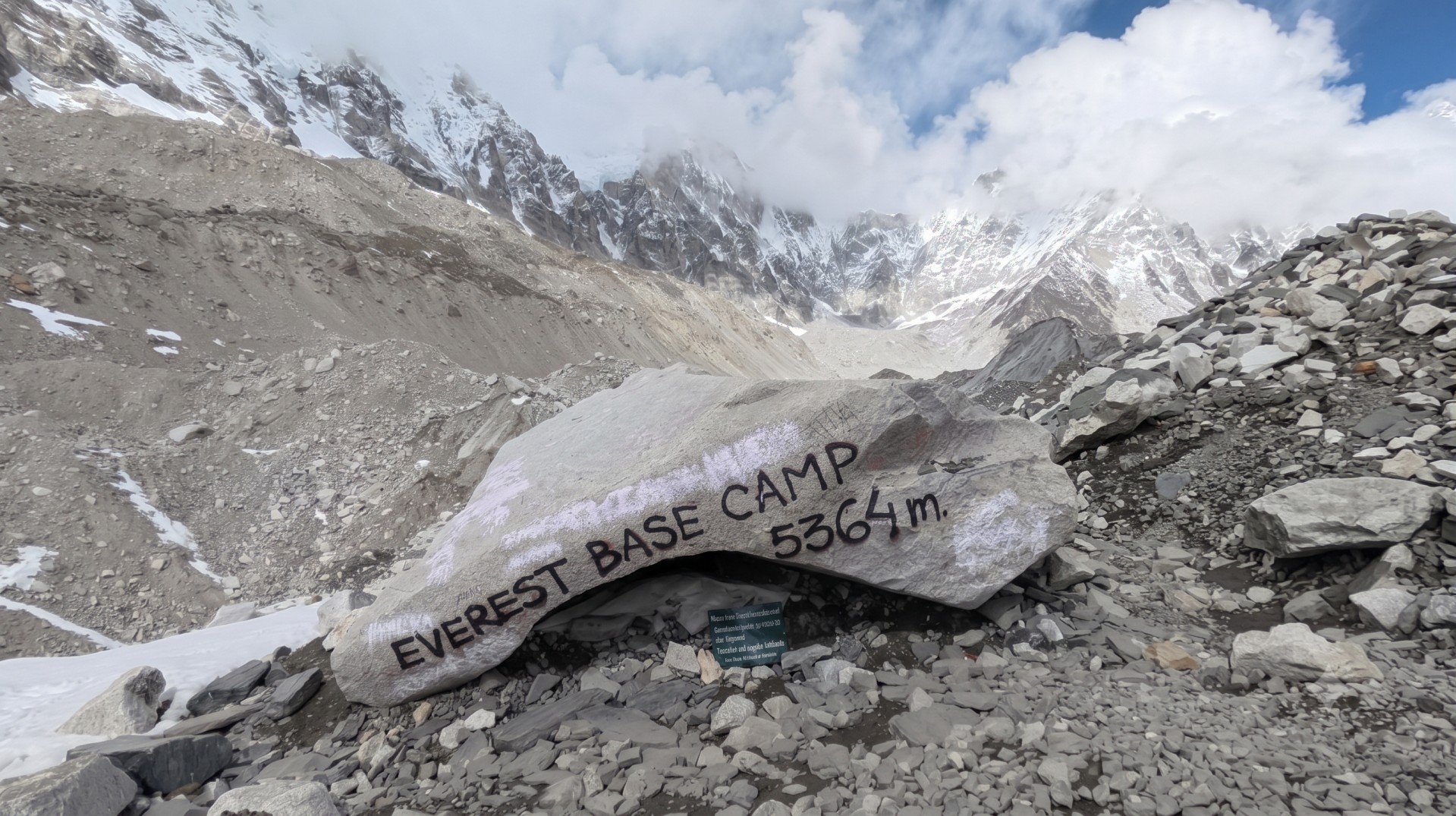
A large glacier boulder, painted in black hand-lettered text — EVEREST BASE CAMP, 5364m — sitting in the Khumbu moraine with Himalayan peaks rising behind it and the glacier sprawling out in every direction. No grand arch, no monument. Just a rock, two words, and a number that took ten days to reach.
I climbed on top and stood there. Took a breath. A deep one. The kind you take when something is over and you are trying to make sure you actually feel it.
Mild symptoms (manageable with rest and hydration): headache, fatigue, reduced appetite, difficulty sleeping, mild dizziness, a low mental haze.
Severe symptoms (descend immediately — do not wait): persistent or worsening headache unrelieved by ibuprofen, confusion or difficulty walking straight, shortness of breath at rest, tightness in the chest, lips or fingertips turning blue.
High Altitude Pulmonary Edema (HAPE) and High Altitude Cerebral Edema (HACE) are life-threatening and can develop rapidly. If in doubt, descend. No summit or checkpoint is worth the risk.
The headache was splitting, the air was thin, the trail had taken everything. And I was standing at 5,364 metres on a painted rock at the foot of the highest mountain on earth.
Behind the stone: Everest itself. Mighty, vast, filling the sky in a way photographs simply cannot hold. On the way back, somewhere between the glacier and the moraine, I stopped and looked up one more time. Nimsdai's words came quietly to mind — "Giving up is not in the blood, sir."
One day I'll climb you.
On the return we hired horses — Kansa was mine, 8,000 NRS — the legs had made their position clear. Back at the tea house. Lunch. Cards. Eventually, without a formal vote, everyone agreed to take the helicopter back to Lukla. It just became the plan. Dinner. Bed by 7:30. Sleep came but not cleanly — breathing laboured, restless, the altitude doing what altitude does in the night. Hot water: 600–800 NRS.
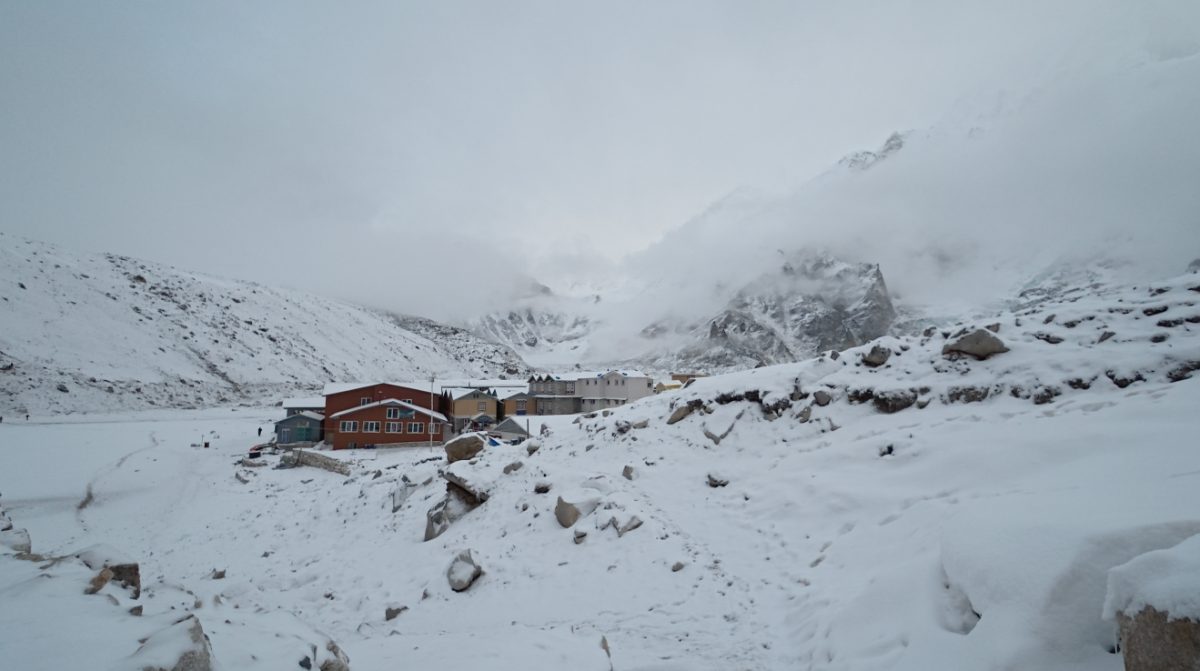
Woke up to silence. Then looked outside. Heavy snowfall overnight — the whole landscape buried and white and still. That explained the difficult breathing. At altitude, snowfall drops oxygen levels further and your body spends the night working harder than it should.
We waited until 8 for the weather to clear enough for the helicopter. It did not. Plan B: horses to Pheriche. 16,000 NRS. My horse was Raja.
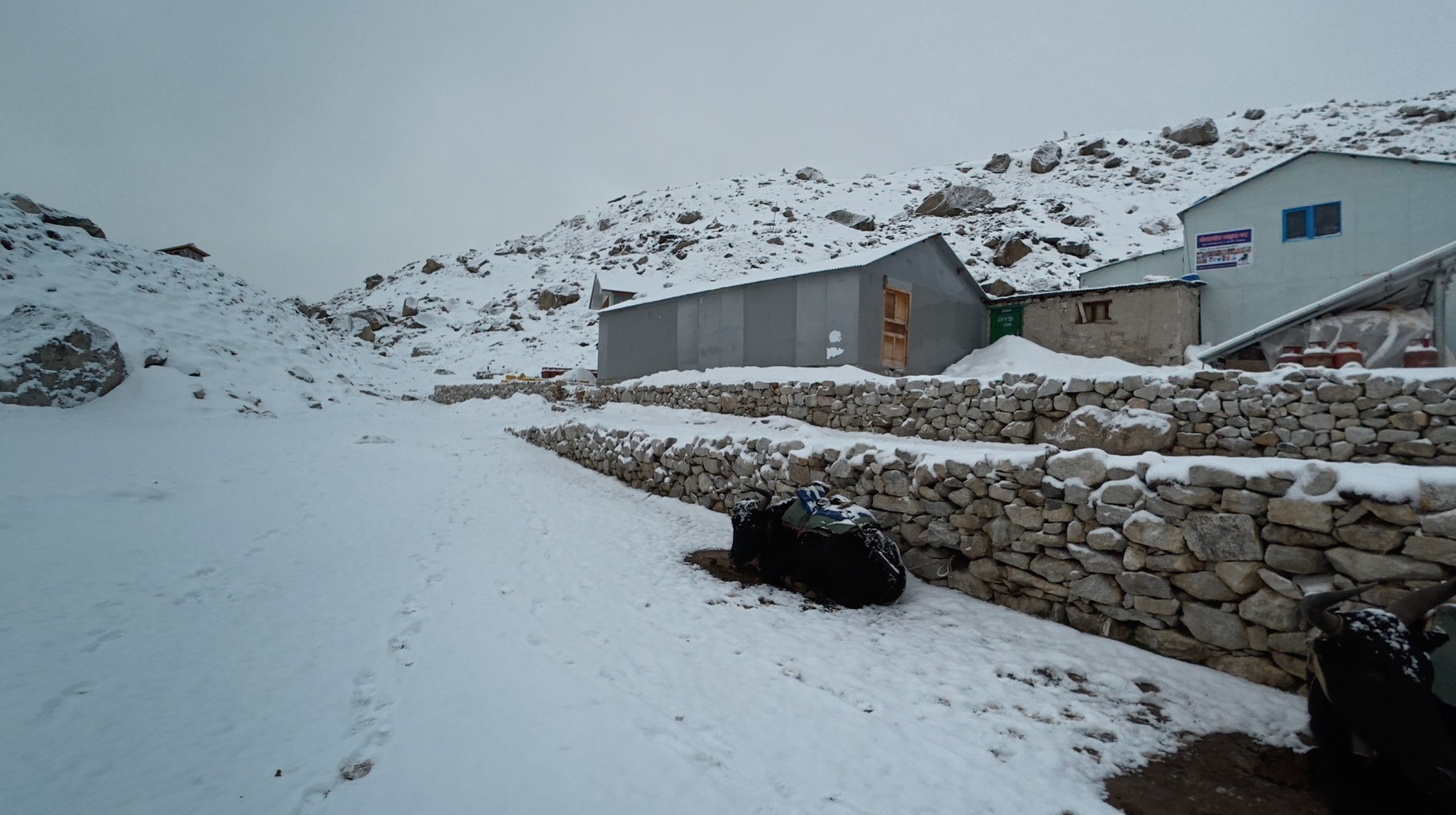
The descent was hard and the trail treacherous — snow-covered, slippery, steep in sections. The horses knew the path but the conditions did not care. Raja slipped once, caught himself, kept going. Another horse was not as lucky — it went down, injuring its leg. Blood dripping onto the white snow, bright red against all that white.
You do not forget that image. A reminder of how hard it is to simply survive up here, and how Sherpas have been doing this for generations — without complaint, without crampons, without anyone watching. Several sections were too risky to ride. We dismounted and walked.
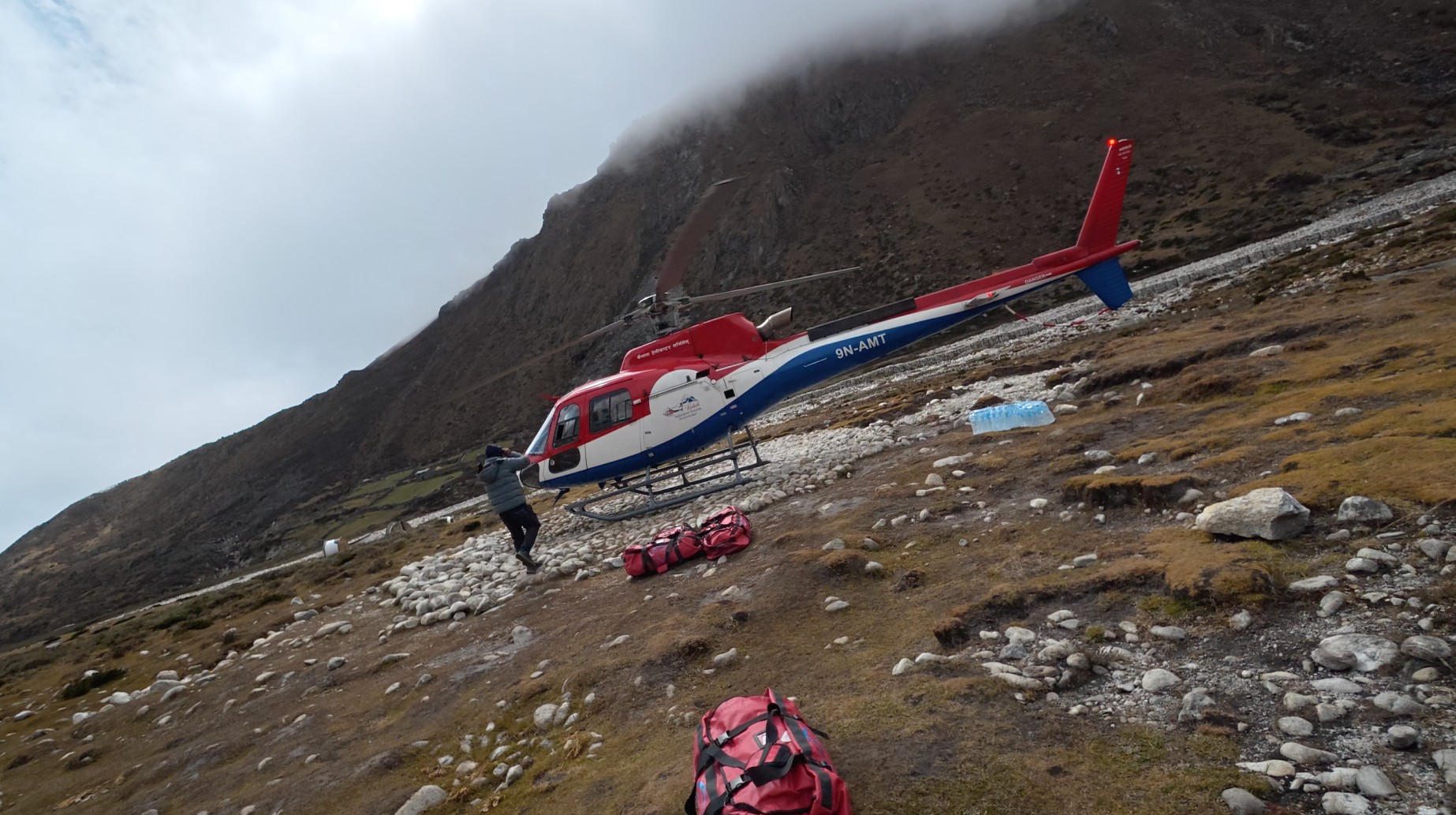
Four hours to reach Pheriche. Arrived with severe headache and dizziness — still no Diamox, but the body was clearly done negotiating. Waited another hour for the weather to open a window. The helicopter came — 1,100 USD per helicopter, three helicopters for the group. Ten minutes to Lukla. My first ever helicopter ride. Looking down at the valleys and trails we had spent ten days walking, everything compressed into ten minutes of flight, was something I will not forget.
Back at Hotel Numbar in Lukla. We pushed for a flight to Kathmandu that evening. Bad weather. No flights. Booked for 7:30 AM the next morning — Tara Air. Explored Lukla market, bought souvenirs. Dinner. Bed by 8.
Up at 5. Breakfast at 7. At the airport by 7:15. Then the waiting began. Lukla airport runs on its own logic — flights cancel without warning, boarding passes appear on no fixed schedule, and patience is the only currency that works. We checked in and got boarding passes after an hour of uncertainty. Tara Air, scheduled for 10. We boarded at 11.
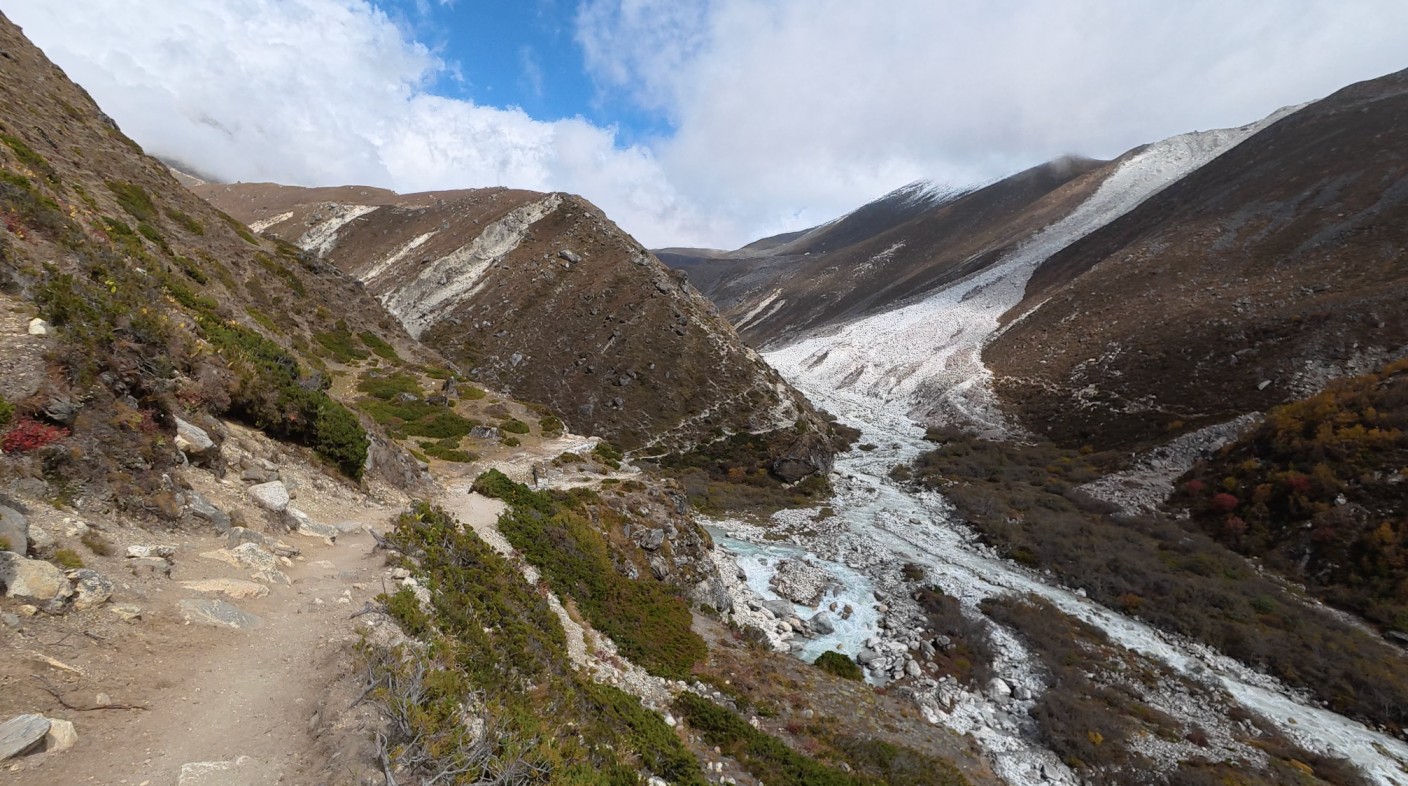
The 45-minute flight back to Kathmandu. Valleys, monasteries, rivers, waterfalls — the landscape unspooling below like a slow exhale. Everything that had taken ten days to walk, passing beneath in under an hour.
Landed around 1 PM. Back to Hotel Manang. The headache was gone. Finally, properly gone. The dizziness had lifted. The body had come back down to an altitude it recognised.
That night I ran a hot bath. Sat in it for a long time. Remembered what luxury felt like. Remembered what comfort was. After twelve days of 500 NRS hot water and squat toilets and sleeping in four layers, a bathtub in Kathmandu felt like the greatest thing on earth.
But more than that — I thought about the Sherpas carrying double weight without crampons, the horses bleeding on white snow, the memorial stones at Chukpi Lhara, the thin air that humbled every step. The mountains do not care who you are or what you think of yourself. You stand at the foot of Everest and you understand, properly, how tiny you are. How fragile. How much we take for granted every single day.
I came back a different person. Not dramatically, not overnight — but something shifted that I do not think shifts back. The mountain teaches you that survival is hard, that kindness is a choice people make anyway, and that the most extraordinary things on this earth ask nothing of you except that you show up and pay attention.
A final word for Laxman, Purna, Yuddha and Suresh — our guides who knew every turn of this trail and never let you forget it was possible. Always smiling, always at the back waiting for the last person, always the first to push you forward when the altitude was winning. The trek doesn’t happen without them.
Woke up at 9. No alarm. No trail. No altitude. Full buffet breakfast at Hotel Manang, unhurried. Then out into Kathmandu with the whole day to spend however I wanted.
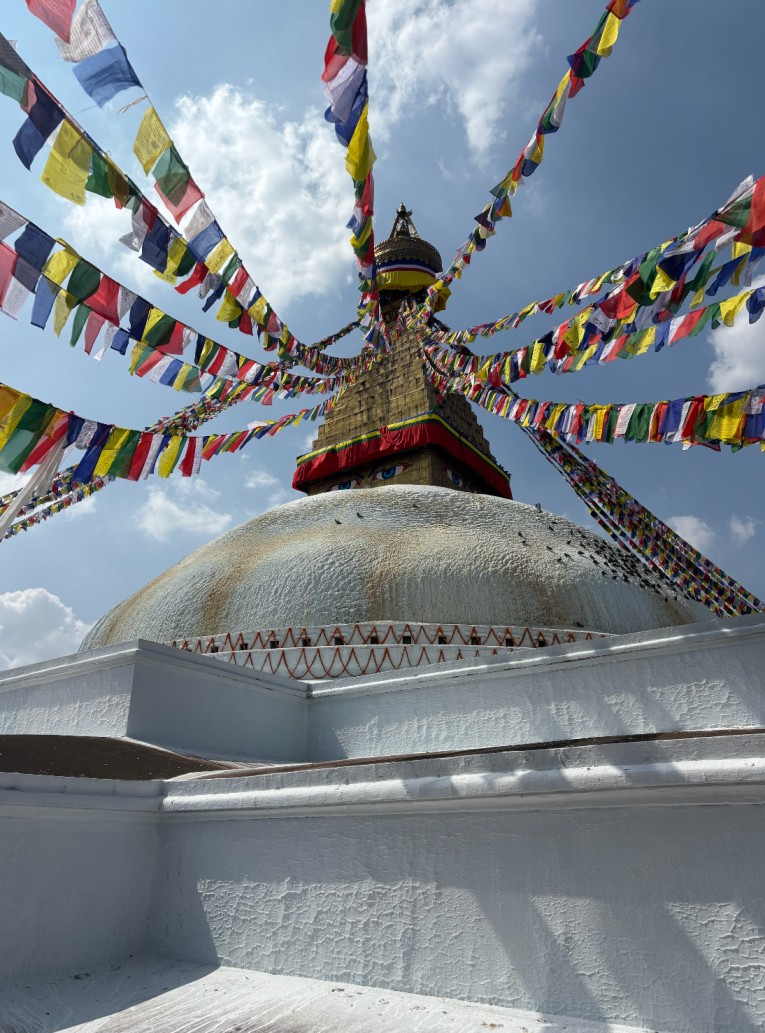
First stop: Boudhanath Stupa. One of the largest stupas in the world, ringed by prayer wheels and monks in saffron, the all-seeing eyes of Buddha looking out in every direction. Pilgrims circling clockwise, prayer flags in every colour overhead. After ten days in the silence of the mountains, the quiet ceremony of this place felt right.
Then Pashupatinath Temple. Along the banks of the Bagmati River, bodies were being cremated in the open — publicly, ritually, as they have been for centuries. Families gathered on the ghats. Smoke rising. Life ending in plain sight, without curtain or ceremony of concealment. It hit hard. Ten days ago I was on a mountain where survival demanded everything. And here, in the middle of a city, was the other end of it — the final stop, unhidden, unashamed, simply true.
I stood there for a long time.
From there, to a completely different kind of goosebumps: Nimsdai's store, near the Marriott. Nirmal Purja. The man who climbed all 14 eight-thousanders in six months and six days, shattering a record that stood for seven years. His store is filled with photographs, gear, the weight of what he has done laid out quietly in front of you. I stood there thinking about my ten days. My 5,364 metres. My first summit at Nangkartshang. My painted rock. He did 14 eight-thousanders in six months. The mountain humbles you. But people like Nimsdai remind you what human beings are capable of when they decide to find out.
Evening in Thamel. One last walk through the noise and the neon. The city that had welcomed me two weeks ago with a garland, sending me off quietly. Flight to Chennai the next morning. Bags packed. Head full. A different person than the one who landed here thirteen days ago.
Was it worth it?
Every headache. Every 2:30 AM alarm. Every 500 NRS cup of hot water. Every squat toilet. Every step I questioned. All of it. The mountain does not give you anything for free. That is exactly why it is worth everything.
Not taking things for granted. Understanding how tough survival is in the mountains. How tiny we are, yet how much ego we carry. How friendly people are — Sherpas, fellow trekkers, locals. I am still paying attention.